Key Takeaway
The 2026 Fort Wayne buyer wants move-in ready — not a project. Investing in "clean and tight" mechanicals, warm neutral aesthetics, and professional staging creates compound ROI that far exceeds the cost. This playbook shows exactly how to prepare your home to maximize sale price.
Introduction: The Evolving Landscape of Northeast Indiana Real Estate#
The residential real estate market in Fort Wayne, Indiana, as it enters the operational year of 2026, represents a distinct departure from the frenetic, unregulated velocity of the post-pandemic era. We are witnessing a maturation of the market cycle where the fundamental dynamics of supply and demand are reasserting themselves, albeit under the weight of sustained interest rates in the mid-6% range.
Market Shift Alert: The narrative that "everything sells" is obsolete. The 2026 buyer in Fort Wayne is not seeking a project—they are seeking a sanctuary.
For stakeholders associated with Indiana Home Match and the broader Allen County real estate ecosystem, the strategy for listing preparation must shift from a passive reliance on market momentum to an active, calculated optimization of the asset.
While inventory remains constrained due to the "lock-in effect"—where homeowners with sub-3% mortgages are reluctant to trade up to higher rates—buyers have become increasingly discriminating. They are financially qualified but liquidity-constrained, meaning they possess the credit capacity to purchase a home but lack the excess cash reserves to fund immediate renovations.
The Central Thesis: Preparation of a property before listing has transitioned from a cosmetic option to a fiduciary necessity for sellers aiming to maximize net proceeds.
This comprehensive guide integrates behavioral economics, building science, aesthetic trend forecasting, and proprietary market data to establish a definitive protocol for home preparation. Our analysis demonstrates that "clean and tight" mechanicals, combined with sophisticated "warm neutral" aesthetics and professional staging, create a compound return on investment (ROI) that far exceeds the cost of implementation.
Market Context: The Fort Wayne 2026 Ecosystem#
To advise sellers effectively, one must first diagnose the specific economic conditions of the local market. Fort Wayne, unlike volatile coastal markets, is projected to see modest, sustainable growth rather than dramatic corrections.
The Stabilization of Pricing and Inventory#
Forecasting data indicates that the wild swings in home prices are leveling off, with a projected appreciation of approximately 3.3% for the 2026 calendar year. This "modest growth" signals stability, which appeals to conservative Midwest buyers.
However, the days on market (DOM) metric is creeping upward for unstaged or "average" inventory. This creates a bifurcated market:
- "Turnkey" homes ignite bidding wars because they are scarce
- Homes requiring work sit stagnant because the buyer pool for "fixer-uppers" has evaporated due to the high cost of renovation financing and labor
Buyer Demographics and Psychographics#
The dominant buyer profile in Fort Wayne for 2026 is the "Millennial Move-Up" buyer and the "Downsizing Boomer." Both demographics converge on a single requirement: convenience.
The Millennial Move-Up Buyer:
- Often maxing out debt-to-income ratios to afford the purchase
- Values experiences over maintenance
- Views a "project house" not as an opportunity for equity, but as a threat to lifestyle and free time
The Downsizing Boomer:
- Selling larger family estates to move into manageable, high-finish properties in neighborhoods like Aboite or Northwest Allen County
- Has the capital but lacks the desire to manage contractors
Both groups are searching for "quiet confidence" in a home—a property that feels mechanically sound and aesthetically resolved. They are risk-averse, making the tolerance for surprise repairs non-existent.
The Neighborhood Micro-Climates#
Strategies must be nuanced by location:
Aboite Township: Buyers here are driven by school districts and family logistics. Preparation must emphasize durability—mudrooms, stain-resistant flooring, and high-efficiency mechanicals.
West Central / Downtown: Buyers seek historic charm but fear historic maintenance. The "clean and tight" strategy here involves ensuring 100-year-old windows are sealed and basements are dry, mitigating the fear of "money pits."
Northwest Allen County: This is the luxury tier. Allowances are non-starters. The expectation is specific, high-end finishes (quartz, hardwood) that align with 2026 trends.
The Psychology of the Transaction: Why Emotion Wins#
Real estate is often discussed in terms of bricks and mortar, but the transaction is fundamentally a psychological event. In 2026, the successful sale is engineered by triggering specific neurochemical responses in the buyer.
The Halo Effect and First Impressions#
Behavioral research confirms the existence of the "Halo Effect" in home buying. This cognitive bias leads a buyer to interpret ambiguous information about a home based on their initial impression.
Critical Window: The first impression is formed within the first 10 seconds of entering the property. Every sensory input matters.
If a buyer walks into a foyer that smells of vanilla, is lit by warm 2700K light, and features a pristine floor, they subconsciously categorize the entire property as "well-maintained." Conversely, a single negative sensory input—a musty smell, a flickering bulb, a scuffed baseboard—triggers the "Horn Effect," causing the buyer to view even positive features with suspicion.
Pre-listing preparation must prioritize the "arrival experience":
- Curb appeal
- Front door condition
- Scent upon entry
- Immediate sightlines
Decision Fatigue and the Turnkey Premium#
Modern buyers suffer from decision fatigue. The average individual makes thousands of decisions daily. When purchasing a home, the prospect of making hundreds more decisions regarding carpet color, paint swatches, and contractor selection is overwhelming.
The Cognitive Load: A home requiring updates imposes a heavy cognitive load. A move-in ready home removes this load. Buyers pay a premium for the absence of decision-making.
The Visualization Deficit: Approximately 90% of buyers cannot visualize a space differently than it is presented. They cannot look past a purple wall to see a neutral one; they see work. Staging creates the visualization for them, bridging the gap between "house" and "home."
The Fallacy of the "Allowance"#
A common error among sellers is the belief that offering a "flooring allowance" or "paint credit" is mathematically equivalent to doing the work. It is not.
| Factor | Why Allowances Fail |
|---|---|
| Friction Cost | Transfers labor of sourcing materials, scheduling contractors, and managing the project to the buyer—often valued higher than the cash credit itself |
| Trust Deficit | When a seller offers an allowance for worn carpet, the buyer wonders: "If they didn't care enough to replace the dirty carpet, did they change the furnace filter? Did they service the water heater?" |
| Financial Mechanics | Most first-time buyers have limited cash post-closing. They cannot use the allowance to pay a contractor until after they own the home, and lenders often won't allow credits for repairs |
The Bottom Line: By replacing flooring before listing, the value is baked into the sale price, allowing the buyer to finance the improvement over 30 years rather than paying cash immediately.
The "Clean and Tight" Protocol: Building Science as a Sales Tool#
Before aesthetic considerations, the property must meet the "clean and tight" standard. In the Midwest, where climate extremes are a reality, this phrase transcends cleanliness—it refers to the integrity of the building envelope.
Defining "Clean and Tight"#
"Clean" refers to a level of hygiene that mimics a hospitality standard, not merely a residential one.
"Tight" refers to the control of air infiltration and the solidity of mechanical connections.
Building Envelope Integrity: A "tight" house has minimized air leakage. This involves:
- Sealing rim joists
- Weather-stripping doors
- Ensuring windows close and lock with a satisfying mechanical "thud" rather than a rattle
This tactile feedback communicates quality.
Energy Efficiency: In an era of rising utility costs, a tight home is a marketable asset. Drafty homes are viewed as "yesterday's children," inefficient and costly. Sealing gaps around plumbing penetrations and electrical outlets is a low-cost, high-yield maintenance task that serves as a proof point of seller diligence.
The Maintenance Audit Checklist#
To achieve this standard, sellers should execute a rigorous audit prior to the first showing:
| System Component | Required Action | Buyer Perception Benefit |
|---|---|---|
| HVAC System | Service unit, replace filter with high MERV rating, clean ducts if necessary | Signals "worry-free" winters; improves indoor air quality smell |
| Windows & Doors | Clean tracks, replace worn weatherstripping, tighten hinges and handles | Tactile proof of security and maintenance; reduces draft complaints |
| Plumbing | Fix all drips, re-caulk toilets and tubs (remove old caulk first), tighten faucet handles | Prevents fear of water damage/mold; implies fastidious ownership |
| Electrical | Replace all non-working bulbs, ensure switch plates are clean and straight | "Bright" equals "Clean." Removes subconscious visual friction |
| Exterior Envelope | Power wash siding, clean gutters, seal penetrations for cable/pipes | Curb appeal; suggests no rodent/pest intrusion points |
The Legal and Psychological "Broom Clean"#
While the standard real estate contract in Indiana may only require a home to be "broom clean" at possession—defined as free of debris and personal property—this is the standard for closing, not listing.
Listing a home that is merely "broom clean" effectively leaves money on the table. The "listing standard" must be "hotel ready"—sanitized, depersonalized, and mechanically perfect.
Title Clarity: The Ultimate "Tight" Detail#
A "clean" home also refers to the title. Sellers must ensure there are no liens, encroachments, or unresolved boundary disputes. Discovering a title defect during the pending period is a primary cause of deal collapse, which can stigmatize the property if it has to come back on the market.
Aesthetic Calibration: The 2026 Design Palette#
Once the home is mechanically sound ("tight"), it must be visually optimized. The aesthetic trends for 2026 mark a decisive shift away from the "Flipper Gray" that dominated the previous decade.
The Death of Gray and the Rise of "Warmth"#
The defining trend for 2026 is "Warmth." Buyers are rejecting the sterile, cool grays that defined the 2015-2024 era in favor of earthy, organic tones that foster a sense of grounding and calm.
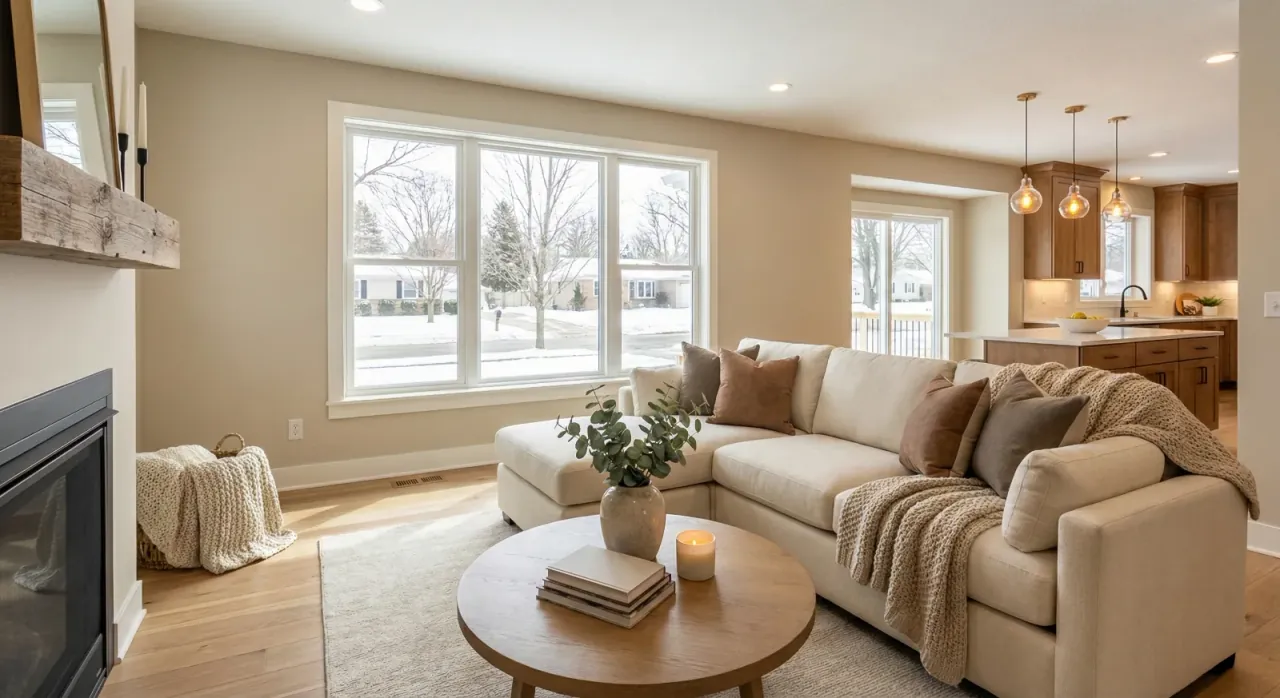
2026 Color Trend: "Universal Khaki" and warm beiges are replacing gray as the go-to neutral. These colors pair beautifully with natural wood tones often found in Indiana homes, bridging the gap between traditional and modern.
Key Color Trends:
- Universal Khaki: A warm, neutral beige that serves as the cornerstone of the 2026 palette
- Warm Eucalyptus: Valspar's 2026 Color of the Year signals a biophilic trend—bringing the outdoors in
- Color Drenching: A sophisticated technique where baseboards, walls, and ceilings are painted the same color (with varying sheens), making small rooms feel larger
Specific Paint Recommendations for Resale#
For sellers painting their interiors in 2026, the following specific colors are recommended by design professionals to maximize broad appeal:
| Brand | Color Name | Code | Application Strategy |
|---|---|---|---|
| Sherwin Williams | Universal Khaki | SW 6150 | Primary Neutral: Use in main living areas, hallways, and open-plan spaces to create warmth |
| Sherwin Williams | Alabaster | SW 7008 | Trim/Ceiling: A soft, warm white that avoids the sterility of "Ceiling White" |
| Sherwin Williams | Neutral Ground | SW 7568 | Bedrooms: A softer tan/greige that is lighter than Khaki, perfect for relaxation zones |
| Benjamin Moore | Swiss Coffee | OC-45 | Whole House: A versatile off-white that works exceptionally well in older homes with lower light |
| Benjamin Moore | Revere Pewter | HC-172 | Transition: The perfect "greige" for sellers worried about going too beige; bridges gray and brown |
Flooring Strategy: Hardwood vs. Vinyl#
Flooring provides the foundational aesthetic of the home.
Hardwood: Refinishing existing hardwood floors yields the highest ROI of any remodeling project, recovering approximately 147% of the cost. Buyers in the Midwest value the longevity and authenticity of wood.
Luxury Vinyl Plank (LVP): While popular for rentals and basements due to water resistance, LVP offers a lower ROI (50-60%) compared to wood. It should be used strategically in wet areas (kitchens, baths, basements) but not to cover good hardwood.
Carpet: If carpet is retained, it must be professionally cleaned and look "tight" (no wrinkles). If it is stained, replacement is mandatory. The buyer's tactile experience of walking on new, plush carpet creates a subconscious feeling of luxury and cleanliness.
Lighting Temperature: The Kelvin Scale Imperative#
Perhaps the most overlooked aspect of preparation is lighting temperature. The "color" of light is measured in Kelvins (K).
Critical Mistake to Avoid: Sellers often install 5000K (Daylight) bulbs thinking "brighter is better." This is wrong. 5000K light appears sterile, clinical, and cold—subconsciously signaling "hospital" rather than "home."
The 2026 Standard: The ideal range for residential showing is 2700K to 3000K (Warm White/Soft White). This range mimics the warm glow of incandescent bulbs, making skin tones look healthy and rooms feel cozy.
Lighting Temperature Guide for Sellers
| Room / Area | Recommended Kelvin | Effect | Bulb Type Recommendation |
|---|---|---|---|
| Living Room | 2700K - 3000K | Cozy, inviting, relaxing | LED Soft White |
| Bedroom | 2700K | Warm, restful, sanctuary | LED Warm White |
| Kitchen | 3000K | Clean, bright, but not blue | LED Bright White |
| Bathroom | 3000K | Flattering to skin tones | LED Bright White (Avoid Daylight) |
| Exterior | 3000K | Welcoming, highlights landscaping | LED Flood/Porch |
Action Item: Audit every bulb. Ensure consistency. A room with mixed 2700K and 5000K bulbs feels chaotic and cheap.
Strategic Home Staging: The ROI Engine#
Home staging is the process of merchandising a home to appeal to the widest possible buyer pool. In 2026, it is not an optional expense but an investment with a quantifiable return.
The Mathematics of Staging (2025 Data)#
Data from the Real Estate Staging Association (RESA) for 2025 provides compelling evidence for staging:
Return on Investment: A $4,000 staging investment that prevents a $20,000 price drop yields a massive return.
Velocity of Sale: Staged homes sell 73% faster than unstaged homes. In Q3 2025, staged properties averaged just 19 days on market.
Price Premium: Staged listings consistently sell for 7-13% over list price, as the emotional connection drives competitive bidding.
Levels of Staging Services#
Sellers can choose from a hierarchy of staging services based on their budget and property status:
Level 1: The Consultation (DIY)
- Description: A professional stager conducts a walk-through and provides a detailed "action plan" or report. They specify paint colors, decluttering zones, and furniture arrangement. The seller performs the labor.
- Cost: $150 - $600
- Best For: Sellers with time and labor capacity; occupied homes with acceptable furniture
Level 2: Soft Staging (Vignette Staging)
- Description: The stager brings in accessories—artwork, rugs, lamps, throw pillows, and greenery—to supplement the homeowner's existing furniture. This updates the "look" without the cost of furniture rental.
- Cost: $400 - $700 one-time fee + monthly rental
- Best For: Occupied homes that need a style refresh to align with 2026 trends
Level 3: Full Vacant Staging
- Description: For empty homes, the stager provides furniture for key rooms (Living, Dining, Kitchen, Primary Bedroom).
- Cost: $2,000 - $6,000+ for the initial 60-day term
- Best For: Vacant homes, new construction, and flips
- Rationale: Empty rooms lack scale. Buyers cannot judge if a queen bed fits in a bedroom without a physical reference. Vacant staging defines the space and purpose of each room.
Sensory Staging: Beyond the Visual#
Advanced staging in 2026 involves multi-sensory marketing:
Olfactory (Smell): Use simple, single-note scents like Vanilla or Citrus. Complex scents (potpourri) can trigger headaches. The scent should be subtle, signaling "clean."
Auditory (Sound): Play soft, instrumental music (jazz or classical) during showings. This masks exterior noise and fills the "awkward silence," allowing buyers to converse comfortably.
Tactile (Touch): Buyers will touch countertops and handrails. Surfaces must be chemically clean and smooth. Texture plays a role in "cozy" staging—chunky knit blankets and velvet pillows invite touch.
Depersonalization and Mindset Adoption#
To successfully sell, the homeowner must psychologically detach from the property, viewing it as a product rather than a home.
The Depersonalization Protocol#
The "Usage Rule": If an item will not be used in the next three months, it should be packed. This clears closets, making them appear larger.
Identity Removal: Family photos, diplomas, and religious or political artifacts must be removed. These items mark the territory as "yours," preventing the buyer from visualizing it as "theirs." Political items, in particular, risk alienating 50% of the potential buyer pool.
Clutter and Cortisol: High levels of visible clutter raise buyer cortisol (stress) levels. A stressed buyer does not write an offer. Clear countertops act as a "visual palette cleanser."
Adopting the "Seller's Mindset"#
The seller must adopt a mercantile mindset. The house is a commodity. Every decision—painting, cleaning, staging—is a business decision calculated to maximize yield. The emotional attachment to the "family home" must be suspended in favor of the strategic objective: the highest possible net proceeds.
Cost vs. Value: Investment Analysis#
Understanding the return on investment for various improvements helps sellers prioritize their pre-listing budget:
| Improvement Project | Estimated Cost | Estimated ROI (Resale Value) | Notes |
|---|---|---|---|
| Garage Door Replacement | $4,300 | 349% | Highest ROI project; boosts curb appeal instantly |
| Entry Door (Steel) | $2,400 | 216% | Security + Aesthetics. Paint in "Warm Eucalyptus" for trend |
| Manufactured Stone Veneer | $11,700 | 208% | Updates 1990s facades significantly |
| Hardwood Refinish | $3,000 - $5,000 | 147% | Best interior ROI; essential for older Fort Wayne homes |
| Minor Kitchen Remodel | $28,000 | 113% | New hardware, paint cabinets, quartz counters (no layout changes) |
| Carpet Replacement | $3,000 - $6,000 | 100% + Speed of Sale | Necessary to remove odors and "ick factor" |
Pro Tip: Focus on high-impact, visible improvements rather than major structural renovations. Buyers value the improvements they can see and touch during the showing.
Conclusion: The 2026 Winning Strategy#
The Fort Wayne real estate market of 2026 rewards preparation and punishes passivity. The winning strategy for sellers is a holistic approach that integrates:
- Technical Rigor: "Clean and tight" building maintenance
- Psychological Leverage: "No-allowance" turnkey presentation
- Aesthetic Appeal: Warm, staged interiors aligned with 2026 trends
By adhering to these protocols, sellers can transcend market averages, achieving faster sales velocities and higher net proceeds in an increasingly competitive landscape. Before you list, run your numbers through our seller net proceeds calculator to see what you'd actually walk away with at different price points.
Key Takeaways#
- The 2026 Fort Wayne market is bifurcated: turnkey homes sell fast, fixer-uppers languish
- "Clean and tight" mechanicals are non-negotiable for capturing top-of-market value
- Warm neutrals (Universal Khaki, Alabaster) have replaced gray as the 2026 color palette
- Lighting temperature (2700K-3000K) dramatically impacts buyer perception
- Professional staging delivers 2,334%-4,415% ROI and sells homes 73% faster
- Allowances fail because they transfer cognitive load and signal neglect
- First impressions are formed in 10 seconds—the arrival experience is critical
What is the most important improvement I can make before selling in 2026?
The highest ROI improvement is hardwood floor refinishing (147% return), but the most critical is achieving the 'clean and tight' standard—ensuring all mechanicals are serviced, all minor repairs are completed, and the home is spotlessly clean. This creates buyer confidence and prevents the 'Horn Effect' where one negative observation taints their entire perception.
Should I offer an allowance for carpet replacement instead of doing it myself?
No. Allowances create friction and signal neglect. Buyers cannot visualize past worn carpet, and they question what else has been neglected. Replace stained or worn carpet before listing. The cost is financed into the buyer's 30-year mortgage rather than requiring immediate post-closing cash.
What paint colors should I use in 2026?
The 2026 trend is warm neutrals. Recommended colors include Sherwin Williams Universal Khaki (SW 6150) for main living areas, Alabaster (SW 7008) for trim, and Benjamin Moore Revere Pewter (HC-172) as a versatile greige. Avoid cool grays—they read as dated in the 2026 market.
Is staging really worth the cost?
Absolutely. Data shows staging delivers 2,334%-4,415% ROI. Staged homes sell 73% faster and for 7-13% over list price. A $4,000 staging investment that prevents a $20,000 price reduction or speeds the sale by 2 months (saving 2 mortgage payments, taxes, and insurance) pays for itself many times over.
What is the 'clean and tight' standard?
Clean means hotel-level hygiene—spotless, sanitized, and odor-free. Tight refers to building envelope integrity: sealed windows, weather-stripped doors, no drafts, and all mechanical systems serviced and functioning perfectly. This standard creates buyer confidence and prevents suspicion of hidden problems.
How important is lighting temperature?
Critically important and often overlooked. Use 2700K-3000K (Warm White) bulbs throughout the home. Avoid 5000K (Daylight) bulbs, which create a harsh, clinical feel that subconsciously signals 'hospital' rather than 'home.' Consistent, warm lighting makes spaces feel inviting and makes skin tones look healthy.
This comprehensive strategic report represents the current best practices for residential real estate disposition in the Fort Wayne, Indiana market as of January 2026. Market conditions evolve, and sellers are encouraged to consult with local real estate professionals for personalized guidance.
Contact Indiana Home Match for a professional pre-listing consultation and staging assessment to maximize your home's market value.